

The Babel Syndrome
Notes from a parent, agency lead, nonprofit director, and artist who lets Claude plan the grocery list but won't let it near the actual ideas

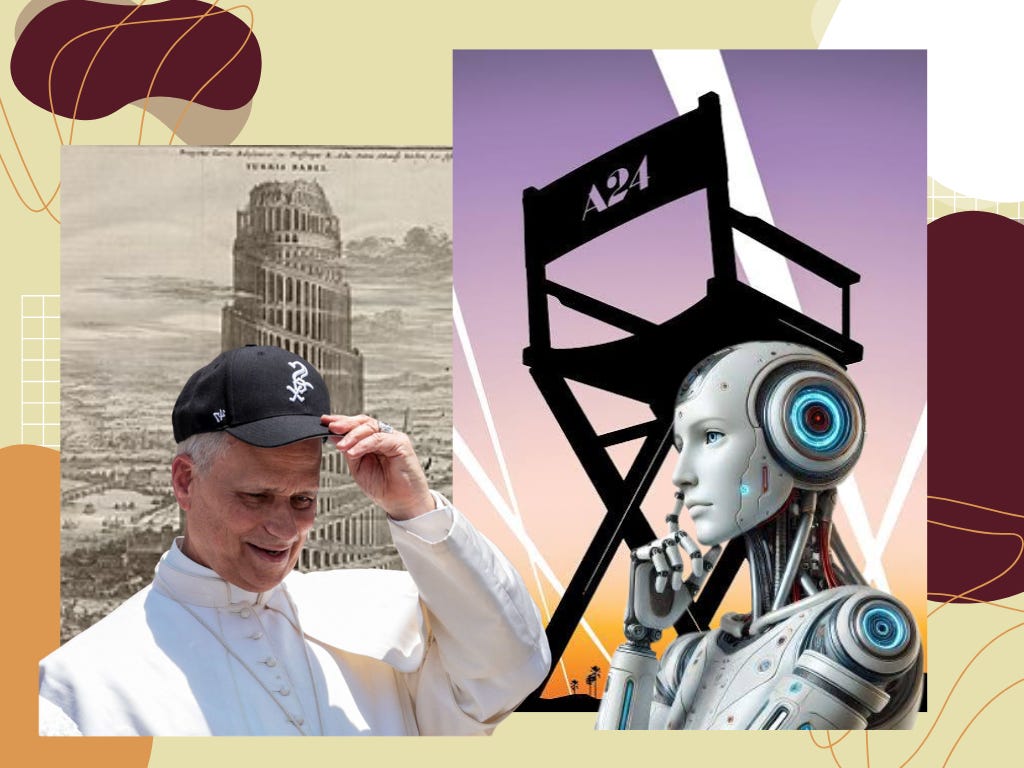
I’ve been referencing “the pope manifesto on AI” all summer. To anyone who will listen — my agency team, my board at The Gallery ATX, my husband over dinner when he clearly wants to talk about something else. Officially it’s called Magnifica Humanitas, Pope Leo XIV’s first encyclical, released this past May, on safeguarding the human person in the time of artificial intelligence. Unofficially, it’s become my favorite piece of evidence that I am not the only person feeling two things at once about AI: I use it constantly, and I think the way it’s being built is going to cost us something we can’t easily get back.
The core argument isn’t “AI is evil.” It’s narrower and, I think, more useful than that. Leo’s issue is with advancing AI whose intent is to replace human workers — and the dignity that work gives people — in service of corporate profit rather than the common good. He’s not writing as a technophobe. He’s writing as someone worried about who the innovation is for.
His best move is reaching all the way back to Genesis. He references the story of Babel — not as a story about a tower, but about a city, “a project conceived without reference to God, supported by a uniformity that eliminated diversity and that chose homogenization over communion.” The point isn’t that ambition is dangerous. It’s that ambition without difference, without room for anyone else’s voice, collapses in on itself. And then, crucially, he notes how the story doesn’t end there: “the city is reborn, now... through the shared responsibility of all.” Not one genius. Not one model. Everyone, rebuilding together.
From there he names the thing directly: the “Babel syndrome” — “idolatry of profit that sacrifices the weak, a uniformity that neutralizes differences, and the pretense that a single language — even a digital one — can translate everything, including the mystery of the person, into data and performance.”
That last phrase is the one I can’t shake. The mystery of the person, into data and performance. Because that’s the trade being pitched to us constantly right now, in boardrooms and pitch decks: that a person’s judgment, taste, and lived experience can be compressed into a dataset, and that the compression is progress.
Leo also gets specific about work itself, in a way that felt almost too on the nose for what I do for a living: “through work, human beings bring their freedom, creativity and capacity for cooperation into play, contributing to the cultural and moral elevation of society. In light of this, the various kinds of job insecurity, fragmented career paths and automation must not be evaluated solely in terms of efficiency, but in relation to the dignity of the worker, the right to sufficient remuneration and the genuine possibility of participating in society.”
Not solely in terms of efficiency. I want that sentence stitched into every AI roadmap I’ve ever sat through.
That line stopped feeling abstract to me this month, watching a lawsuit unfold at Meta. Twenty-six former employees are suing the company, alleging it used AI — activity trackers, token-usage dashboards, algorithmically assisted performance rankings — to help decide who got cut in this year’s layoffs, and that the scoring structurally penalized anyone on protected medical, parental, or disability leave, because those metrics simply can’t be earned while you’re out. Meta says human managers made the final calls, and a judge declined to block the layoffs while the case proceeds, but even the unresolved version of this story is the Babel syndrome with a spreadsheet attached: an efficiency metric standing in for judgment, applied to people whose circumstances it was never built to see. Zoom out and the broader labor data is more nuanced than “the robots are coming for your job” — recent research suggests AI is mostly augmenting experienced workers’ output while squeezing entry-level hiring and specific junior tasks, not causing blanket displacement. But nuance doesn’t help much if you’re the one on leave when the token-usage dashboard runs.
Last year I was part of an internal team at my agency trying to build an actual ethical framework for how we used AI — one that accounted for sustainability and, just as much, for preserving original human thought and creative instinct. It went nowhere. Not because anyone thought it was a bad idea. It went nowhere because the question that killed it was: how does this grow the business? A framework built around protecting human judgment doesn’t have a clean answer to that question, and so it quietly stopped being a priority.
I want to be upfront that I’m not writing this from some purist remove. I use AI constantly. At my agency job, I lean on Copilot in Teams to draft deck outlines when I’m up against a deadline, or to help me punch up a slide title into something that actually lands. At The Gallery ATX, where I do nonprofit work with a board of volunteers and no marketing budget, we use it to draft copy because the alternative is nothing gets drafted at all. In my personal life, Claude plans my workout routines, my travel itineraries and packing lists, my grocery lists when we’re hosting. I genuinely don’t think I could hold all the roles I hold right now — parent, agency lead, nonprofit director, artist — without offloading the administrative weight of my life onto something that can move fast.
So this isn’t an argument against the tool. It’s an argument about what the tool is for. AI is exceptional at expediting timelines and getting me to execution faster. It is not, and was never supposed to be, a replacement for original thought.
Which is exactly where I start getting frustrated with how the industry is actually deploying this stuff. Take A24 — a studio whose entire identity is built on breaking the formulaic model of filmmaking, on being the place where a weirder, more human vision gets made — recently taking a $75 million investment from Google to build AI-powered filmmaking tools with DeepMind. A24 Labs, led by Scott Belsky, is careful to frame this as workflow optimization, not IP replication: AI-generated storyboards, production tools, the kind of thing Martin Scorsese has already put his name behind. Belsky’s pitch is that this partnership is different because it’s not selling “cheaper and faster” as the goal.
Maybe. I want to believe the distinction holds. But it’s hard not to notice the pattern: the entities that got famous for resisting homogenization are the ones being recruited to help build the infrastructure of homogenization for everyone else. That’s the Babel syndrome in a press release.
It’s not that every AI project has to end up there, though. There’s a team out of the University of Chicago — the Glaze Project, which builds the tools Glaze and Nightshade — doing something closer to what Leo is actually describing. They make free technical tools that let artists disrupt unauthorized AI training on their own work: Glaze disguises a style so it can’t be scraped and mimicked, Nightshade actively poisons a dataset if a model trains on it without consent. It’s funded by research grants and donations, not venture capital, built explicitly to hand leverage back to the human creative instead of the platform. Nightshade alone was downloaded more than 300,000 times in its first two months on the market. It’s proof that “AI project” and “profit-driven homogenization” aren’t actually synonyms. They just describe most of what gets funded.
And the discourse is starting to catch up to the discomfort. Substack just launched an AI detection tool built with Pangram, letting readers scan any post over 100 words for an estimate of how much was AI-generated, alongside a new space for writers to disclose how they used AI in a piece. The announcement was unusually blunt about why — it took a direct shot at the flood of AI-generated “engagement” on LinkedIn and coined a term for the fauxthentic version of it: “Claudefishing,” faking a human connection with AI-smoothed text. It’s a pointed move, and also a genuinely risky one, because even the best detection tools aren’t reliable. The Atlantic dug into just how imperfect Pangram actually is: it boasts an impressively low false-positive rate, meaning it rarely falsely accuses a human of using AI, but a considerably higher false-negative rate, meaning it regularly misses AI-generated text altogether, especially anything lightly edited. That asymmetry matters, because the entire pitch is “trust this to tell you the truth,” and “usually, except when it quietly doesn’t” is a strange foundation for a reputation system.
I don’t think the answer is a detector that promises certainty it can’t deliver. I think the answer is closer to what Leo is actually arguing: AI doesn’t have personal experience or a moral center to draw from when it’s reasoning through an ethical dilemma. Humans do. That’s not sentimentality, it’s just accurate. A model can help me get to a draft faster. It cannot have sat in the room, made the call, and lived with the consequences of it.
So here’s where I’ve landed, at least for this summer. Use the tool for what it’s actually good at — clearing the administrative underbrush so there’s more room for the thinking that only a person can do. And stay suspicious of anyone, whether it’s my own agency or a studio I love or a platform I write on, who frames the conversation as pure efficiency instead of asking the harder question underneath it: efficiency for whom, and at whose expense. The city gets rebuilt through the shared responsibility of all, not through one company’s roadmap. That’s worth holding onto.
++++++++++++++++++++++++
Reb Carlson is a brand and digital marketing strategist specializing in cultural relevance for luxury, travel, and lifestyle brands. She has led brand marketing for HUGO BOSS, Evian, Marriott, Master & Dynamic, and others — and currently serves as President of The Gallery ATX, an Austin-based nonprofit amplifying underrepresented artists through community programming and exhibitions.
If something here sparked an idea for your brand, she’d love to talk → https://www.rebcarlson.com/consulting